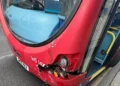
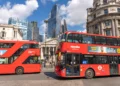
Alexander Dennis has demonstrated new emergency braking technology at the launch of Transport for London’s latest bus safety standard.
The manufacturer attended the Bus Safety Standard Phase 2 launch at UTAC Millbrook, where it displayed the Enviro100EV, Enviro200EV and Enviro400EV.
A video from the event shows Pedestrian Advanced Emergency Braking being demonstrated on the Enviro100EV. The system is designed to detect people or objects in front of the vehicle and automatically apply the brakes if the driver does not respond to a hazard.
The measures are intended to reduce the risk of deaths and serious injuries involving buses, while improving safety for passengers, drivers, pedestrians, cyclists and other road users.
The updated standard builds on the first phase introduced in 2018, which brought in measures including improved driver direct vision, warning systems and safer vehicle design.
Alexander Dennis said it has supported TfL’s bus safety programme since 2018 and has worked with the transport authority on technology aimed at reducing collisions and serious injuries on the network.

Image © Alexander Dennis
New technology aimed at preventing collisions
Pedestrian Advanced Emergency Braking is one of the key systems demonstrated by Alexander Dennis during the launch.
The wider Phase 2 programme also includes a Moving Off Information System, which is being developed to prevent a bus from moving away if a pedestrian or cyclist is immediately in front of the vehicle.
Advanced Emergency Braking systems are also expected to be improved to give greater protection to vulnerable road users.
Another planned measure is low acceleration suppression technology, designed to reduce the risk of a bus accelerating too quickly if the accelerator is pressed unintentionally.
More than 40 buses are expected to trial new safety systems before any wider rollout across the fleet.
What it means for London buses
The latest requirements are expected to influence future vehicle orders placed by London bus operators for TfL-contracted routes.
For passengers, the measures are aimed at improving onboard safety and reducing the risk of injury. For drivers, the technology is intended to provide additional support in busy road conditions, while keeping the driver in control of the vehicle.
The new standard also reflects TfL’s wider Vision Zero aim to eliminate deaths and serious injuries from London’s transport network.
London Bus Forums News previously reported that Phase 2 includes a wider package of safety changes, including improvements to driver cab design, lighting, braking systems and technology to reduce the risk of collisions.
More updates can be found in our Transport for London news section.
Read our earlier report below:
New safety standards announced for London buses