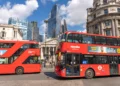
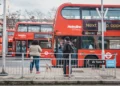
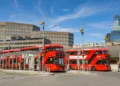
Route 6 will become the first service run by the new TfL-owned operator from late 2027.
Transport for London has announced a new publicly-owned bus company which will begin running services in late 2027. Buses for London will initially operate route 6 between Willesden and Victoria, with Park Royal confirmed as the company’s first depot.
TfL currently contracts bus services out to eight different privately-owned operators over almost 700 routes. However, Mayor of London Sadiq Khan’s proposal marks a shift towards bringing some bus services back under public ownership for the first time since the 1990s. Plans for a public bus company were first proposed in early 2026 under the TfL Business Plan, with route 6, which runs from Bertie Road, Willesden, to Victoria Station, being the first service to come under direct TfL ownership.
TfL said: “Buses for London will help TfL test new approaches to innovation, operational efficiency, safety, decarbonisation, customer experience and driver welfare, while maintaining the high standards Londoners expect from the capital’s bus network.”
TfL said it is working in partnership with the Old Oak and Park Royal Development Corporation (OPDC) to establish Park Royal Depot as the Buses for London operational base for connections across west and central London. This will include supporting around 100 new zero emission buses. The lease for the Park Royal Depot expires in 2033 and will then be moved to a permanent location.
TfL’s Director of Buses, Lorna Murphy, said: “The depot will provide a base for cleaner, greener services, helping us to build on the progress we’ve already made towards a more sustainable transport system.”
The union Unite, which represents bus workers in the capital, welcomed the plans, with general secretary Sharon Graham calling the move a “positive step”, citing the failure of private firms to provide efficient transport services or adequate working conditions for workers.
Wayne King, the Unite national officer for passenger transport, added that this was “just the beginning”.
“While this is an important step forward for London’s bus network, there are still issues in London buses generally that need to be resolved. We will not stop until all our members are treated with the dignity and respect they deserve for keeping the capital moving.”
It has been reported that Transport for London currently has a backlog of deferred capital renewals costs of around £6.5 billion, with TfL estimating it needs to invest between £1.1 billion and £1.2 billion per year in order to maintain its assets in a steady condition.

Image: London Assembly
Sadiq Khan has recently come under pressure from the London Assembly which recently unanimously voted to support a motion in favour of the Bus Driver Bill of Rights, a list of 12 demands from independent bus workers which highlight the degraded working conditions in which they are forced to work at risk to their own health and the public’s safety.
Tom Kearney, of London Bus Watch, questioned the timing of TfL’s announcement and the safety governance of the new company.
He stated: “Given the barrage of frightening reports about the systemic problems which help to explain TfL’s poor bus safety performance and unsafe bus driver working conditions, I suspect that today’s announcement about “Buses for London” is an attempt by City Hall to deflect attention away from the fact that, in the exact words of former TfL Board Director (2012-18) and Board Safety Panel Michael Liebreich:
“London has the least safe bus system of any major city. The causes are not difficult to work out:
- The contract structure and iBus system incentivise speeding;
- TfL abdicates responsibility for bus driver working conditions (hot and cold cabs, lack of toilets, working hours that would be illegal in the freight industry, a toxic working culture);
- Unite the Union is supine and compromised because it’s the Mayor’s biggest donor;
- the regulator, which is the Traffic Commissioners for Great Britain, has an annual budget for the whole country of… get this… less than £2m.
- The UK has no Road Accident Investigation Board, unlike for Rail, Maritime or Air accidents.”
Because the safety regulation framework for buses does not provide a robust, detailed safety code specifically for bus operations, TfL’s bus contract itself must serve as the safety regulator. Since 2001, even though it serves as the sole contractor of public bus services in London, TfL has manifestly refused to fill the gap between the essentially non-existent national bus safety framework and high public expectations that buses must be reliable. Accordingly, systemic safety problems associated with TfL’s contracted buses are effectively unregulated, as has been well evidenced by over a decade of Driver complaints about, inter alia, hot bus cabs, fatigue-inducing rosters/rotas and lack of toilets, well-evidenced systemic problems about which the Mayor and Transport Commissioner have always pleaded ignorance.
Letting the same, in my opinion, negligent, untransparent & overpaid City Hall politicians and TfL bureaucrats who’ve financially incentivised Bus Operators only for reliability & not for safety for the past 25 years, to now own & operate bus services begs the question: will the contract between TfL and “Buses for London” just be a cut and paste version of TfL’s existing [Quality Incentive Contract] or will Sadiq Khan, as TfL Chairman, instruct TfL to inscribe the Bus Drivers Bill of Rights into the new contract?
“Will the Mayor’s decision be a ‘new chapter’ for London’s buses or merely a rehash of the same ‘Institutionally Unsafe’ contracted bus operation over which the Mayor has presided since 2016?”
Tom Kearney, London Bus Watch