
TfL has acknowledged pedal confusion may be under-reported, raising questions over the true number of incidents across London’s bus fleet.
More than 200 incidents involving London bus drivers pressing the wrong pedal have been recorded in seven years, raising fresh concerns about the safety of vehicles operating across the capital.
Figures released by Transport for London show 229 cases of pedal application error between January 2019 and December 2025, including 40 last year. The true number of incidents could be higher, with TfL having previously acknowledged that pedal confusion is likely to be under-reported.
In October 2024, the Mayor of London acknowledged that the absence of footwell cameras on more than half of the capital’s bus fleet made it difficult to establish whether drivers had mistakenly pressed the wrong pedal.
In a response to a Mayor’s Question from Neil Garratt in July 2024, the Mayor confirmed that, among its world city peers, Transport for London is the only authority mandating the use of pedal cameras on buses, which suggests that the alarming frequency of pedal confusion incidents may be unique to London.
Research commissioned by TfL also found that nine per cent of 593 survey respondents, including 567 current bus drivers, had experienced unintended acceleration in the previous year.
Of the 53 respondents who reported such an experience, 85 per cent said it had not resulted in a collision, although researchers cautioned that the findings were indicative and could not be considered representative of the wider workforce.
Pedal confusion occurs when a driver mistakenly presses the accelerator believing they are applying the brake, potentially causing a bus to accelerate suddenly and without warning.

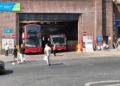
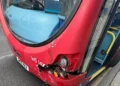
Image: London Bus Forums
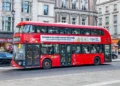
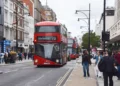
The problem has previously been linked to London’s New Routemaster buses, commonly known as Boris buses, although it can occur in other vehicle types.
TfL confirmed in 2019 that drivers of New Routemasters had reported 28 collisions between September 2013 and January 2019 in which unintended acceleration or pedal confusion was said to have been a factor.
At the time, TfL said it had not issued specific instructions to operators concerning additional training for New Routemaster drivers, although companies had introduced their own safety initiatives.
London Bus Forums News understands that a route H98 bus which crashed into a building in Hayes in August was involved in an incident of pedal confusion.
A source with knowledge of the incident said footage from a camera monitoring the driver’s pedals was reviewed following the collision.
Joe from Better Buses, a London bus driver behind the YouTube channel, believes more needs to be done to understand why such incidents happen and how they can be prevented.
Speaking to London Bus Forums News, he raised concerns about differences between vehicles, driver distractions and the technology available to reduce the risk of unintended acceleration.
In a video examining the issue, he said: “In my view, pedal confusion isn’t about a bad driver, it’s about a mine hidden in the system.”
He also questioned whether differences in acceleration and braking between diesel, hybrid and electric buses could affect how drivers respond in an emergency, highlighting the importance of understanding why a driver might continue pressing the accelerator while believing they are attempting to stop.
The consequences can be devastating.
In August 2021, 32-year-old Melissa Burr was killed at Victoria bus station after an electric bus struck the rear of another stationary bus, shunting it forwards into her as she used a pedestrian crossing (cf. 14 September London Bus Forums “TfL faces prosecution over alleged safety failures after woman killed at Walthamstow bus station”)
The driver, Olusofa Popoola, admitted causing her death by careless driving after mistakenly pressing the accelerator instead of the brake.
He was handed an 18-month suspended prison sentence in January 2024.
TfL subsequently apologised to Ms Burr’s family after incorrectly reporting that she had been walking between buses when the collision happened.
Her death remains one of the most serious examples of the consequences of pedal confusion on London’s bus network.
The issue has also raised questions about whether existing safety measures go far enough to prevent similar incidents.
Footwell cameras, which record drivers’ pedal movements, became a requirement for new London buses in May 2019.
The cameras allow investigators to establish whether the accelerator or brake was being applied before a collision, but do not themselves prevent a driver pressing the wrong pedal.
Research commissioned by TfL has also suggested higher recorded rates of pedal application error among New Routemasters and electric buses than some other vehicle types.
However, researchers warned that differences in camera coverage could be influencing the findings, as incidents are more likely to be identified on buses equipped with footwell cameras.
The research does not establish that New Routemasters have a design defect or that any particular recent collision was caused by pedal confusion.
Questions have also been raised about whether drivers receive sufficient practical training to recognise and recover from pedal errors.
A TfL-commissioned study published in April 2025 examined 13 pieces of safety guidance and briefing material supplied by London bus operators.
Researchers found that only one included a practical demonstration and assessment, while the remaining materials consisted of posters and leaflets.
The report identified opportunities for more practical training, including simulated scenarios to help drivers recognise errors and regain control.
During his discussion with London Bus Forums News, Joe from Better Buses also raised concerns about the wider working environment faced by drivers, including fatigue, distractions and excessive temperatures inside bus cabs.
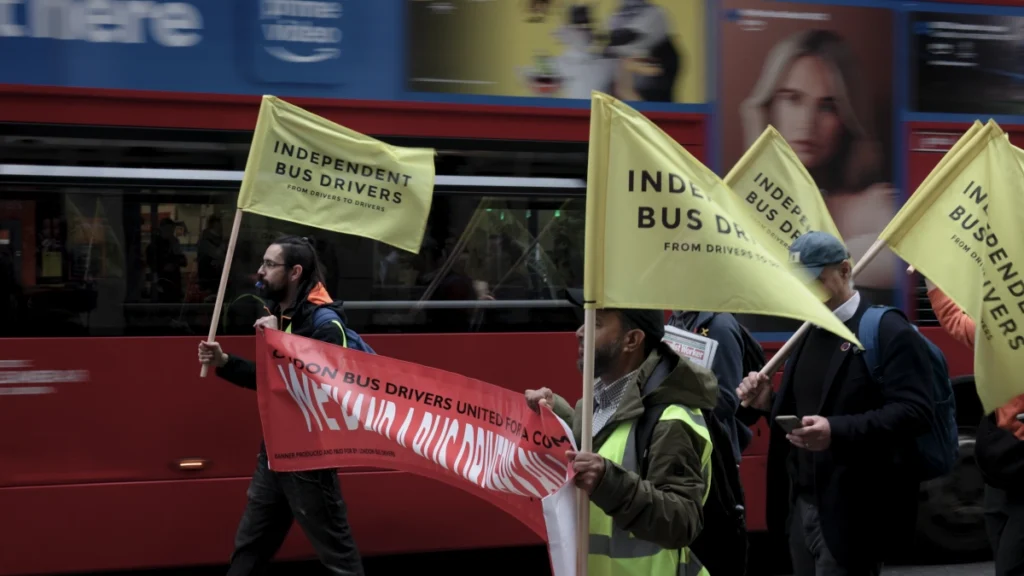
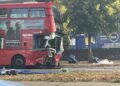
Image: London Bus Forums
Those concerns have also been raised by independent London bus drivers, who have staged demonstrations outside TfL’s headquarters calling for a 12-point Bus Drivers’ Bill of Rights to be incorporated into TfL’s Framework Bus Services Contract.
The proposals include safer working schedules, proper rest breaks, functioning heating and air conditioning in drivers’ cabs, improved safety training and protection from being required to respond to controllers’ messages while driving.
The campaign secured political backing in July when the London Assembly unanimously passed a motion supporting the principles of the Bus Drivers’ Bill of Rights and calling on the Mayor and TfL to strengthen protections for drivers.
However, the Mayor has refused to incorporate the proposed rights into TfL’s Framework Bus Services Agreement dating from 1 January 2016, arguing that these rights were already ‘covered by existing legislation, agreements and other measures’ but so far has not provided any evidence to support his assertion. Meanwhile, on 26 June the Mayor admitted on LBC Radio that he was aware that Bus Drivers were being forced by their employers to drive in unsafe conditions and told them to refuse to drive in such cases.
Furthermore, London Bus Forums has published evidence that Arriva Bus Drivers who did follow the Mayor’s instructions were sent home without pay.
Independent bus drivers are planning another demonstration on Thursday, 5 November, as they continue pressing TfL to adopt the 12-point Bus Drivers’ Bill of Rights.
Campaigners are due to gather outside Lambeth North Underground station at 11am before marching to TfL’s Palestra headquarters in Southwark, where they will renew calls for improved working conditions and stronger safety protections.
Campaigners maintain that if the Bill of Rights are incorporated into TfL’s Framework Bus Services Agreement, the relevant clause in each individual bus contract automatically updates to include these protections, a point made succinctly by Keith Prince AM this month in a Mayor’s Question.