The Northern Line, one of the capital’s busiest Underground routes, has entered its fourth consecutive day of severe delays. Transport for London warned on Thursday that disruption is set to continue as engineers struggle to repair a persistent signal failure at Stockwell station.
The problem began on Sunday, 19 October, and has caused chaos throughout the working week. Commuters have been left stranded, platforms have become dangerously overcrowded, and alternative Tube routes have come under immense pressure. Transport for London has repeatedly urged passengers to avoid the Northern Line where possible and to seek alternative routes until the fault is resolved.
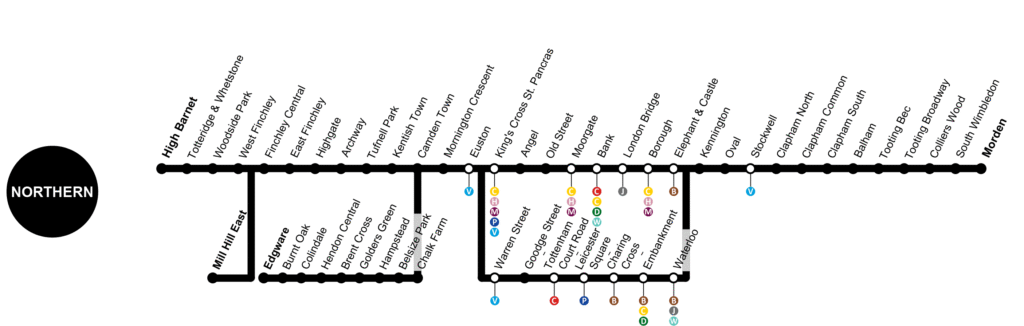
A spokesperson for Transport for London confirmed that the delays are the result of a critical failure in the line’s signalling system at Stockwell, a key interchange on the southern section of the route. Engineers are working around the clock to resolve the issue. The spokesperson apologised to all customers affected by the disruption and promised that every effort is being made to restore full service as soon as possible.
© london-tube-map.info
The knock on effect has been felt well beyond the Northern Line itself. With nearly a million daily journeys typically made on this route, the pressure on other Tube lines and London’s bus network has been intense. Many passengers have reported severe overcrowding on the Victoria, Central, and Piccadilly lines, as well as long waits for buses at key interchanges.
For commuters, the impact has been immediate and deeply frustrating. One City worker at London Bridge said their usual journey from Morden to Bank, typically a straightforward trip, has taken more than an hour and a half each way this week. There have been queues simply to get onto the platform. Similar stories have been shared across social media, with many reporting missed appointments, lost wages, and mounting stress.
Transport for London’s advice remains unchanged. Passengers are being urged to use alternative Tube lines, National Rail services, or London buses wherever possible. At stations including Stockwell and Kennington, staff have been deployed to direct crowds and provide updates, though many passengers have complained that information has been inconsistent and queues unpredictable.
Inside the organisation, engineers have been working in shifts day and night to fix the signal failure. The fault is understood to involve a breakdown in the communication system between train drivers and signallers. As a result, trains are being manually talked through the affected area, a safety measure which dramatically reduces capacity and increases delays throughout the line.
TfL was approached for comment and gave this statement. Nick Dent, TfL’s Director of Customer Operations, said, We apologise to customers affected by delays on the Northern line since Sunday. We have identified a fault with the signalling equipment around the Stockwell area that means our service controllers need to manually talk trains through this part of the network.
Our engineers are working hard to identify and fix the fault, including deploying advanced test equipment, and we will do all we can to restore a good service as soon as possible. We are advising customers to allow extra time for their journeys, and to check before they travel using TfL Journey Planner or the TfL Go app.
The disruption has also affected key workers and those making essential journeys. NHS staff, retail workers, and cleaners have reported difficulties getting to their shifts, with some missing work altogether due to unpredictable journey times. One nurse at Euston said it was not just the inconvenience, but the uncertainty, that was most difficult. She described having no idea if she would make it to her shift on time or at all.
Local businesses along the route are also feeling the strain. Cafés and shops near affected stations have seen a sharp drop in trade, while delivery services have faced repeated delays. The manager of a café near Angel said the business relies on the lunchtime rush from commuters, but this week has been exceptionally quiet as people simply are not able to get there.
The timing of the disruption could hardly be worse for Transport for London, which has faced criticism in recent years over the reliability of London’s transport infrastructure. Despite major investments in modernisation, the Northern Line remains one of the oldest parts of the network, with sections dating back to the late nineteenth century. Experts say that while upgrades have improved some aspects, the age and complexity of the line mean that major faults can still have dramatic consequences.
Mayor of London Sadiq Khan has called for a full review once the crisis is resolved. In a statement, he said Londoners expect and deserve a reliable Tube service. He promised a thorough examination of what went wrong and what lessons can be learned to prevent a repeat of this week’s disruption.
As of late Thursday morning, there was still no clear timeline for the restoration of normal service. Transport for London has promised to provide further updates as work progresses but warned that delays could extend into the weekend. Passengers are being urged to check travel alerts before setting out, allow extra time for journeys, and consider working from home where possible.
For many, the events of the past four days have been a stark reminder of the challenges facing London’s transport network and the resilience of those who rely on it every day.