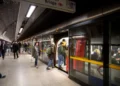
A safety investigation is under way after one of London’s new Docklands Light Railway trains overshot the platform at Canning Town station during heavy rain. The incident happened just six weeks after the new B23 trains were introduced onto the network in an effort to modernise and increase capacity across one of the capital’s vital commuter lines.
Transport for London has confirmed that the train failed to stop as intended, rolling past its designated mark on the platform before eventually coming to a halt. No injuries were reported, but the event resulted in immediate action from officials. All three of the new trains running on passenger routes were pulled from service while engineers began urgent examinations.
Initial findings have pointed to “low adhesion” on the tracks as a key factor. Wet weather conditions likely worsened the problem, leading to insufficient grip between the train wheels and the rails. This is a known hazard for railways, but is usually addressed with advanced braking systems and multiple safety measures. Investigators are now focused on whether the on-board sensors and automated controls responded correctly to the challenging conditions.
Passengers on board during the overshoot described a period of confusion as the train came to an unexpected stop past the end of the platform. Some reported being informed of a “technical issue” over the intercom before staff arrived to assist. While delays were minimal, the incident quickly gained attention across London, as the new fleet was meant to offer an extra layer of reliability through its state-of-the-art technology.

The Docklands Light Railway has been a fully driverless system for decades, carrying hundreds of thousands of passengers each day. The launch of the new B23 trains was supposed to set a new standard, offering more capacity, walk-through carriages and the latest in automatic control systems. Instead, the focus has shifted to safety, with TfL stating that the trains will not return to service until every detail of the incident has been addressed.
Transport for London has reassured the public that the railway remains safe, with the older DLR trains continuing to operate while investigations proceed. The entire B23 fleet, which totals 54 new trains, remains out of service as technical teams work alongside the manufacturer to further test the braking equipment and adjust any systems if required.
This incident has prompted wider debate over the risks and benefits of greater automation in public transport. Advocates say automation reduces the potential for human error and enables higher frequency services that are crucial for a growing city. Critics argue that every new system must undergo exhaustive real-world testing and that well-known problems like wet weather can still present challenges, regardless of technical progress.
Rail industry experts highlight that platform overshoots, though rare, can undermine public confidence in both automation and safety standards. The response from TfL has been swift, with a public commitment to transparency and a promise that the B23 trains will only resume service once all remedial work is complete and independently verified.
A spokesperson for TfL said safety was its absolute priority and that officials were working around the clock to resolve the issue. The manufacturer was also providing direct technical support and further testing is already under way in both simulated and real-world conditions.
For now, passengers can expect normal DLR services to continue using the older fleet. The hope among engineers and city officials is that the investigation will lead to a more robust system, one capable of coping with all conditions faced by London’s railways.
As the probe continues, attention will remain fixed on Canning Town and the outcome of the safety review. For the thousands of commuters who rely on the DLR each day, the message remains clear: public safety comes first, and every train must stop exactly where it should.